No products in the cart.
Electronic systems have evolved rapidly from those large, bulky systems to smaller devices that you can carry in your pocket. This shift pushes toward higher speeds and increased power density, often in much tighter spaces for electronics than before.
Design targets that once required special justification are now assumed. At the same time, expectations around uptime and consistency have not relaxed. Systems are expected to keep working even as operating conditions become harder to control.
Advanced ceramics have become necessary as electronic systems operate closer to their limits. Their ability to insulate, manage heat, and maintain structural stability supports reliable performance in modern designs.
AdValue Technology supplies high-performance ceramics used in electronics applications, helping engineers work with materials that remain predictable under demanding operating conditions.
Advanced ceramics are engineered materials developed to perform in conditions that exceed the capabilities of traditional ceramic products. Unlike conventional ceramics, which are often used for structural or general-purpose applications, advanced ceramics are designed with tightly controlled compositions and processing methods to meet specific electrical, thermal, and mechanical requirements.
These materials are selected because their performance remains predictable as operating conditions become more demanding. Temperature, frequency, and environmental exposure are accounted for during characterization. This allows engineers to evaluate materials based on measured performance under operating conditions, rather than relying solely on nominal ratings.
Materials such as alumina, zirconia, silicon nitride, and aluminum nitride are commonly used in electronic systems. Each of these offers a different balance of properties, giving engineers flexibility to prioritize material capabilities, insulation, heat management, or mechanical reliability. Selection is typically driven by application needs.
Several attributes define why advanced ceramics are widely used in electronics:
Advanced ceramics are used throughout modern electronic systems in roles where material behavior directly affects performance and reliability. Their value becomes most apparent in applications that combine thermal stress, signal sensitivity, and long-term stability. Several core electronic functions rely on ceramic materials for this reason.
Ceramic substrates provide a stable foundation for mounting and interconnecting electronic components. Materials such as alumina, aluminum nitride, sapphire, and fused quartz are widely used in thick- and thin-film substrate applications where heat and electrical performance must be managed together.
They are often selected for the following reasons:
These characteristics allow tighter tolerances and more predictable behavior in high-frequency and high-temperature electronics.
Ceramic materials such as alumina, sapphire, and fused quartz play a central role in many sensing and actuation technologies. Their stability supports accurate measurement and repeatable response in systems that operate continuously or under variable conditions.
Some of the common advantages include:
This reliability is particularly valuable where access for recalibration or replacement is limited.
Many passive electronic components depend on ceramic materials for predictable electrical properties. Capacitors, resonators, and frequency filters rely on ceramics to support stable signal transmission.
Here are some of the key reasons ceramics are used in these components:
As electronic systems move into higher-frequency regimes, the role of advanced ceramics in passives and filtering continues to expand.
Advanced ceramics address material limitations that emerge as electronic systems operate closer to their limits and tolerances. Their ability to manage heat, maintain electrical stability, and perform reliably under stress makes them essential to the continued advancement of next-generation electronic technologies.
Heat management has become one of the defining challenges in modern electronics. As power densities increase, materials must dissipate or withstand heat without degrading electrical or mechanical performance.
Ceramics excel in maintaining stability at temperatures that challenge polymers and many metals. This makes them suitable for various applications. They can be found in power electronics, EV inverters, and high-density computing applications where thermal margins are limited.
The drive toward smaller and lighter electronic systems places additional demands on materials. Components must perform reliably even as spacing decreases and thermal loads concentrate.
Advanced ceramics support miniaturization by combining multiple functional properties in a single material. Their compatibility with manufacturing processes such as screen printing, laser machining, and precision grinding allows complex geometries to be produced at smaller scales.
Electronics increasingly operate in environments that expose them to temperature extremes, vibration, and chemical exposure. Advanced ceramics withstand these conditions with less degradation over time.
This reliability makes them well-suited for aerospace electronics, medical devices, and industrial automation systems, where failure carries significant consequences.
High-frequency systems demand materials that remain electrically stable at GHz ranges. Advanced ceramics offer low dielectric loss and predictable behavior under heat, supporting signal integrity in antennas, filters, and RF modules used in 5G infrastructure.
Power electronics in electric vehicles rely on ceramics for insulation and thermal stability as power levels increase. Heat-resistant ceramic materials help manage thermal stress, extend component life, and support safer, more reliable inverter and charging system designs.
IoT devices and wearables depend on compact components that operate consistently over long periods. Ceramic sensors and connectivity components provide stability in small form factors, with biocompatibility and environmental resistance supporting use in health monitoring applications.
Aerospace and space electronics face extreme temperatures, vacuum conditions, and long service durations. Advanced ceramics maintain performance under these stresses, supporting reliable operation in avionics, satellite systems, and space-based sensing equipment.
Ceramic components used in electronics are typically sourced as standard products or developed as custom solutions. Standard ceramics suit applications with defined requirements and simple geometries, while custom ceramics are used when tighter tolerances, complex forms, or precise system integration become necessary.
The table below highlights key differences between standard and custom ceramic solutions:
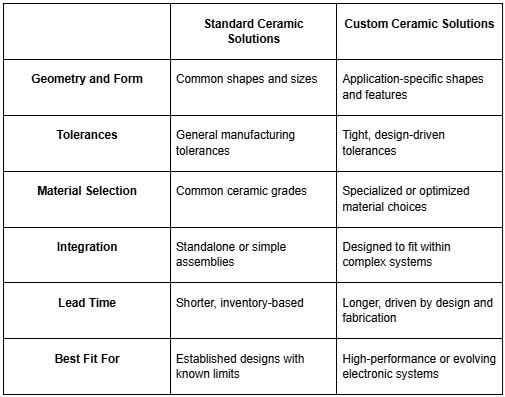
AdValue Technology supports standard and custom ceramics used in electronics. Standard ceramic products are available for applications with defined requirements, while custom-engineered ceramics provide the flexibility needed for complex electronic designs that cannot accommodate compromise.
Selecting ceramics used in electronics involves evaluating several material properties. Dielectric constant influences signal behavior. Thermal conductivity affects heat management. Mechanical toughness and coefficient of thermal expansion influence reliability and integration.
Engineers often ask practical questions during this process:
AdValue Technology assists with material selection and specification by focusing on application requirements. This approach helps align material behavior with system-level performance goals.
AdValue Technology supplies advanced ceramic substrates, high-purity powders, and custom-machined ceramic components used throughout the electronics industry. These materials support applications ranging from prototyping to production.
Technical expertise supports material selection, specification, and integration into electronic systems. Reliable sourcing and responsive delivery help maintain development schedules without introducing unnecessary delays.
For applications that extend beyond standard solutions, custom ceramic capabilities allow components to be tailored to specific performance and integration requirements.
Advanced ceramics have become a cornerstone of modern electronics, supporting systems that must operate under higher thermal loads, tighter tolerances, and more demanding environments. Their ability to manage heat, maintain electrical stability, and perform consistently over time makes them essential to next-generation electronic design.
As technologies continue to evolve, material selection plays a direct role in system performance and reliability. AdValue Technology supports engineers and manufacturers by supplying high-performance ceramic materials and components aligned with real operating requirements.
Contact AdValue Technology to discuss your application or request a quote for advanced ceramic solutions built for high-performance electronics.