No products in the cart.
No material on Earth matches diamond for hardness. That single property drives its widespread use across industrial cutting, drilling, and grinding applications where conventional tool materials wear out too quickly, generate excessive heat, or fail to hold required tolerances. Industrial diamonds are used in cutting, drilling, and grinding tools across nearly every manufacturing sector, from oil and gas exploration to aerospace machining to semiconductor fabrication. This guide explains how they work, why they outperform conventional abrasives, which industries rely on them, and what to consider when choosing diamond tools for your process.
Diamond sits at 10 on the Mohs hardness scale,the highest defined level of mineral hardness . That extreme hardness lets diamond abrasive particles efficiently cut hardened steels, cemented carbides, advanced ceramics, and silicon, where conventional abrasives wear rapidly or lose effectiveness. But hardness alone does not fully explain its dominance. Three properties working together make diamond uniquely suited to industrial tools:
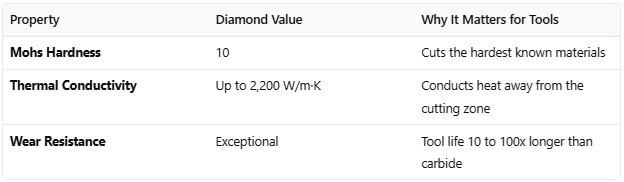
Diamond’s thermal conductivity is the highest of any known material. It prevents heat buildup at the cutting edge, keeps abrasive particles sharp longer, protects the workpiece from thermal damage, and enables higher cutting speeds without sacrificing surface quality.
The vast majority of industrial diamond tools today use synthetic diamonds. Two manufacturing processes dominate: HPHT subjects diamond-forming materials to pressures above 5.5 GPa and temperatures around 1,450°C, replicating natural diamond formation. CVD builds diamond layer by layer from carbon-containing gases in a vacuum chamber, producing exceptionally pure material for specialized cutting and optical applications. Synthetic diamonds cost far less, offer precisely controlled size, shape, and purity, and deliver identical performance to natural diamonds. The global synthetic diamond market is projected to reach USD 38.78 billion by 2030, growing at 7% CAGR, driven almost entirely by industrial tool demand.
Diamond blades are among the most visible industrial diamond tools in manufacturing and construction. A steel or alloy core carries diamond-impregnated segments around its rim, and as the blade rotates, exposed diamond particles cut through the workpiece by abrasive action. Diamond blades handle materials that would quickly wear down conventional carbide blades including concrete, asphalt, granite, marble, ceramic tile, glass, and fiber-reinforced composites. When cutting hard or highly abrasive materials, diamond cutting tools last 10 to 20 times longer than conventional abrasive tools with faster cut rates, reduced blade wear, and lower vibration throughout.
Polycrystalline diamond (PCD) tools represent the premium tier of industrial diamond cutting technology. PCD inserts are made from synthetic diamond particles sintered with a metallic binder, typically cobalt, under high temperature and high pressure. The PCD layer is often bonded to a tungsten carbide substrate, combining the extreme hardness and wear resistance of diamond with the mechanical support and toughness of carbide. .
PCD tools are valued for their long tool life, high cutting efficiency, and ability to maintain sharp cutting edges when machining highly abrasive materials. In suitable applications, PCD tools deliver tool life 10 to 100 times longer than tungsten carbide inserts and hundreds of times longer than high-speed steel. Despite the higher upfront cost, PCD typically delivers much lower cost per part when tool life and reduced downtime are factored in.
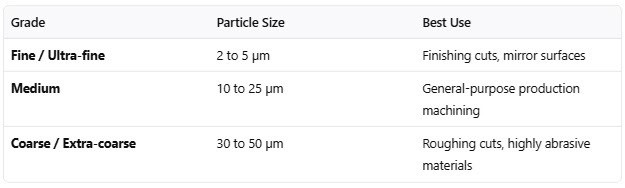
PCD tools excel on non-ferrous metals, fiber-reinforced composites, wood-based products, and advanced ceramics. They are not suited for ferrous metals. The chemical reaction between diamond carbon and iron at machining temperatures destroys PCD edges rapidly. For hardened steels and cast iron, CBN tools are the correct choice.
Not every application requires PCD inserts. Diamond-coated tools apply a thin CVD diamond film over a carbide substrate, delivering improved wear resistance at a lower cost than PCD in suitable applications. These tools are effective for drilling and milling abrasive composites, cutting graphite electrodes, and machining green ceramics and other non-ferrous or nonmetallic materials.
Diamond-tipped wire saws carry individual diamond crystals in a metallic matrix and can cut stone blocks, concrete structures, and silicon ingots with minimal kerf loss and precise geometry control.
Polycrystalline diamond compact (PDC) drill bits remain the leading technology for drilling through hard subsurface rock in oil, gas, geothermal, and mining-related applications. Each bit carries multiple PDC cutters, consisting of a synthetic diamond table bonded to a tungsten carbide stud, arranged across the bit face to match the target formation and drilling conditions. PDC bits shear rock rather than crush it, producing faster penetration rates, more efficient rock removal, and longer cutter life. Key advantages include extended bit life, higher rate of penetration (ROP), cleaner wellbore geometry, effective performance in HPHT wells, and compatibility with directional and horizontal drilling systems. Mining and geological exploration operations use diamond-impregnated core bits for mineral exploration These bits contain fine diamond particles embedded throughout a metallic matrix that wears to expose fresh cutting surfaces as drilling progresses.
Construction uses diamond core drill bits to create precise circular holes through concrete, reinforced concrete, masonry, and natural stone. Unlike percussive hammer drills that crack surrounding material, diamond core drilling produces clean holes with minimal vibration. This is critical near sensitive structures, in seismic zones, and inside occupied buildings. It is also the preferred method for historical structure renovation and urban infrastructure work where structural disruption must be kept to a minimum.
Diamond grinding wheels use diamond abrasive grains bonded into a wheel form that removes material through micro-abrasion as it rotates against the workpiece. They are widely used for sharpening carbide cutting tools, grinding ceramics and hard composites,machining glass and brittle materials, and generating precision surfaces before final finishing. Three bond systems cover the range of applications:
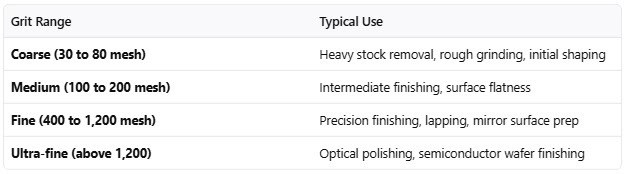
Most precision grinding operations run through progressive grit sequences, moving from coarse stock removal to fine finishing in multiple steps for optimal surface quality.
Aerospace and Automotive: Aerospace uses diamond tools and PCD tools for machining CFRP airframe components, drilling composite panels, trimming composite structures, and processing hard or abrasive nonmetallic materials . In CFRP machining, diamond tooling helps maintain sharp cutting edges, reduce fiber pullout, and lower the risk of delamination compared with many conventional tool materials. Automotive manufacturing depends on PCD tools for high-volume aluminum engine machining, where high-silicon aluminum alloys are too abrasive for conventional carbide at production speeds.
Construction, Mining, and Oil and Gas: Construction uses diamond blades, core bits, and wire saws for concrete cutting and floor grinding. Mining relies on PDC bits for ore body exploration and diamond wire saws for quarrying stone. Oil and gas exploration drives the largest demand for PDC bits by value.
Semiconductor and Electronics: Semiconductor manufacturing uses diamond-based tools and abrasives in wafer slicing, backgrinding, scribing, dicing, edge grinding, and CMP pad conditioning. Diamond dicing blades and scribing tools are used to separate chips from wafers with controlled kerf width and edge quality, while diamond pad conditioners help maintain polishing pad performance during CMP. The precision requirements of semiconductor processing demand tight control over diamond particle size, shape, distribution, and bond quality.
What is the difference between natural and synthetic industrial diamonds? Natural industrial diamonds are mined, while synthetic diamonds are produced through HPHT or CVD processes. Synthetic diamonds dominate industrial tool applications because they cost less, offer precisely controlled particle size and purity, and deliver performance identical to natural diamonds.
Why can’t diamond tools be used on steel? Diamond carbon reacts chemically with iron at cutting temperatures, causing rapid diffusion wear that destroys the cutting edge far faster than normal abrasion. For hardened steels and cast iron, CBN tools provide the required hardness without the chemical compatibility problem.
How long do PCD cutting tools last compared to carbide? PCD tools last 10 to 100 times longer than tungsten carbide inserts in many abrasive applications. Despite higher initial cost, PCD typically delivers much lower cost per part when extended tool life and reduced downtime are included in the calculation.
What grit size should I use for precision grinding? Grit selection depends on the material, removal rate, surface finish requirement, and grinding process. As a general guide, use coarse grades (30 to 80 mesh) for heavy stock removal, medium grades (100 to 200 mesh) for intermediate finishing, fine grades (400 to 1,200 mesh) for precision surfaces. For optical polishing, semiconductor finishing, and other ultra-precision applications, diamond powders are typically specified in micron, submicron, or nanometer particle sizes rather than conventional mesh sizes. .
How do PDC drill bits work in oil and gas drilling? PDC bits shear rock formations by pressing rotating polycrystalline diamond compact cutters against the formation face. Shearing rock rather than crushing it produces higher penetration rates, more efficient rock removal, and longer bit life than conventional roller cone bits. PDC bits dominate modern directional, horizontal, and deep well drilling.
Can diamond tools grind ceramics? Yes. Diamond grinding wheels are widely used for ceramics processing. Silicon carbide, alumina, zirconia, and other advanced ceramics are handled effectively by metal or vitrified bond diamond wheels, producing the surface quality required for semiconductor equipment, medical devices, and aerospace structural components.
What bond system should I choose for my diamond grinding wheel? Metal bond wheels suit aggressive stock removal and offer the longest wheel life. Resin bond wheels produce smoother finishes for precision operations. Vitrified bond wheels are preferred for carbide tool grinding. Consult your supplier about workpiece material, required finish, and operating conditions before specifying a bond system.
The performance of a diamond tool starts with the quality of the diamond material inside it. AdValue Technology has supplied high-purity diamond products and specialty materials to engineers, manufacturers, and researchers worldwide for more than 20 years. Their diamond product portfolio includes:
Custom sizes, orientations, and surface finishes are available to meet your specific tooling or research requirements. Contact AdValue Technology at sa***@*********ch.com or visit the diamond products page to discuss your specifications today.