No products in the cart.
Push an aircraft engine to full thrust and temperatures inside the combustion section easily exceed 1,400°C. Launch a spacecraft and the thermal loads during re-entry climb above 1,600°C. Fly a hypersonic vehicle and leading-edge surfaces face temperatures that most materials simply can’t survive.
Aerospace innovation depends on materials that perform at these extremes. High-temperature metals, specifically refractory metals like tungsten, molybdenum, and tantalum, alongside titanium alloys and nickel-based superalloys, sit at the center of nearly every advance in modern aerospace engineering. Without them, higher engine efficiencies, longer-range spacecraft, and hypersonic flight would remain theoretical rather than achievable.
This guide covers how these metals work, where they’re used, and what makes each one critical to the aerospace systems being designed and built today.
Aerospace engineers don’t get to pick materials based on what’s convenient or cheap. Every component in a propulsion system, airframe, or thermal protection structure must maintain its mechanical properties through rapid temperature cycling, high mechanical loads, corrosive combustion gases, and in some cases, the vacuum of space.
Materials that soften, oxidize, creep, or corrode under these conditions create safety risks and performance failures. The entire history of aerospace propulsion is a story of finding metals that hold up where previous ones failed.
Different parts of an aerospace system face very different thermal environments:
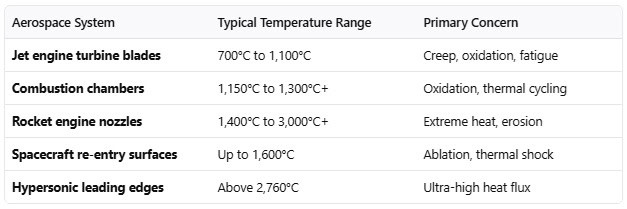
Each of these environments demands a specific combination of thermal stability, mechanical strength, and resistance to oxidation and corrosion. No single material covers every application, which is why aerospace materials engineers work with a portfolio of high-temperature metals tailored to each specific role.
A metal qualifies for high-temperature aerospace use when it maintains its structural integrity well above 700°C. The specific performance requirements vary by application, but common criteria include:
Refractory metals, superalloys, and advanced titanium alloys each meet these criteria in different ways and for different temperature ranges.
Refractory metals are characterized by their exceptionally high melting points, generally above 2,000°C, and their ability to retain mechanical strength at temperatures that would compromise conventional structural metals. The core group includes tungsten, molybdenum, tantalum, niobium, and rhenium. Each plays a distinct role in aerospace applications where few alternative materials can match their capabilities.
According to AZoM’s analysis of refractory metals in aerospace and defense, the US aerospace and defense sector generates approximately $760 billion in annual revenue, with refractory metals playing a central role in both propulsion components and defense systems.
Tungsten holds the highest melting point of any metal at 3,422°C (6,192°F), making ita leading choice for applications involving extreme temperatures where conventional metals cannot perform reliably.. Its density of 19.3 g/cm³ and ability to retain strength at elevated temperatures give it performance characteristics nothing else matches at extreme temperatures.
In aerospace, tungsten finds use in:
AdValue Technology supplies tungsten in multiple forms including sheet, foil, rod, wire, and crucibles, with purity at 99.95% minimum. Alloy compositions including W-Ni-Fe, W-Ni-Cu, and W-Cu are available for applications requiring specific density or machinability characteristics.
Molybdenum melts at 2,620°C and maintains a low coefficient of thermal expansion, which makes it valuable wherever dimensional stability through heating and cooling cycles matters. Its high thermal conductivity and good resistance to thermal shock make it particularly useful in aerospace manufacturing tooling and high-temperature components.
Specific aerospace applications include:
TZM (molybdenum-titanium-zirconium alloy) is one of the most important engineering materials in modern aerospace manufacturing. It offers improved creep strength and recrystallization resistance compared to pure molybdenum, particularly above ~1,300 °C, where many nickel-based superalloys approach their practical limits.
AdValue Technology supplies molybdenum in sheet, foil, rod, wire, tube, and crucible forms with purity at 99.95% minimum, including TZM and Mo-La alloy grades.
Tantalum is one of the most corrosion-resistant metals available. It’s inert to a wide range of l organic and inorganic compounds due to its stable oxide film. That chemical stability combined with a melting point of 2,996°C makes it invaluable in aerospace environments involving corrosive combustion products and aggressive propellants.
In aerospace and defense applications, tantalum serves:
AdValue Technology’s tantalum is available in sheet, foil, rod, wire, tube, sputtering targets, and custom forms including boats, screws, and crucibles. Purity grades include 99.95% and 99.99% minimum, plus tantalum-tungsten alloys (Ta-2.5W and Ta-10W) for enhanced strength in high-temperature structural applications.
Titanium occupies a different role in aerospace than the refractory metals. Where tungsten and molybdenum excel in applications involving extreme temperatures, titanium delivers a strength-to-weight ratio that makes them indispensable for weight-critical structures. That combination, high strength at significantly lower density than steel, drives titanium’s widespread use across airframe structures and engine components.
Titanium’s density sits at approximately 4.5 g/cm³, roughly 40~45% lighter than typica steels while delivering comparable or higher tensile strength in alloy form. Ti-6Al-4V (Grade 5), the most widely used titanium alloy in aerospace, achieves tensile strength of around 900 MPa at a density that allows massive weight savings across aircraft structures.
That weight reduction directly translates to improved fuel efficiency, increased payload capacity, and extended range. Every kilogram removed from an aircraft structure reduces fuel consumption over the lifetime of the aircraft. At the scale of commercial aviation, those savings become significant very quickly.
Titanium also resists corrosion from jet fuels, hydraulic fluids, and the salt air environments common in coastal and marine aviation operations. That corrosion resistance reduces maintenance costs and extends component service life.
Standard titanium alloys operate effectively up to around 315°C to 400°C. Advanced high-temperature titanium alloys extend this range to approximately 500-600°C, making them suitable for compressor sections of jet engines where temperatures are high but below the range requiring nickel superalloys.
Key aerospace applications for titanium alloys include:
Nickel-based superalloys are the materials that make modern jet engine efficiency possible. These engineered alloys are designed specifically to retain their mechanical properties at temperatures that approach their own melting points, a characteristic no conventional structural metal can offer.
The thermal efficiency of a gas turbine engine increases directly with turbine inlet temperature. A 200°C rise in service temperature yields a 5% to 6% increase in turbine efficiency, according to AZoM’s technical review of aerospace alloys. That efficiency gain translates to lower fuel consumption and longer range, which are the primary goals of every commercial and military engine development program.
Nickel superalloys achieve their high-temperature performance through:
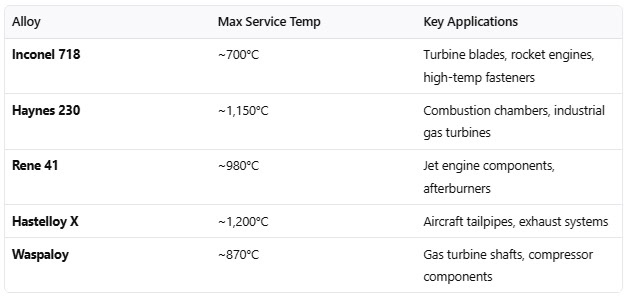
Refractory elements such as molybdenum, tungsten, and rhenium are deliberately added to many nickel-based superalloys to enhance high-temperature strength and creep resistance. For example, alloys such as Hastelloy X and René 41 incorporate molybdenum for solid-solution strengthening. This is where refractory metals like molybdenum connect directly to the superalloy ecosystem that keeps modern aircraft flying.
Jet engine hot sections concentrate the most demanding high-temperature applications in commercial aerospace. Turbine blades, vanes, combustor liners, and exhaust nozzles all require materials that maintain structural integrity through tens of thousands of thermal cycles over the life of the engine.
Nickel superalloys dominate turbine blade applications. Refractory metals, particularly molybdenum in TZM alloy form, handle manufacturing tooling and structural components at the manufacturing stage. Titanium alloys manage compressor stages where temperatures are lower but weight savings are critical. Together these metal families cover the full temperature range of a modern gas turbine engine from intake to exhaust.
Rocket engines face temperatures and pressures that exceed what any jet engine encounters. Combustion chamber temperatures in liquid propellant rockets can exceed 3,000°C, and nozzle throat regions experience extreme erosion from high-velocity combustion gases.
Refractory metals are the leading materials chosen for rocket nozzle throats, heat shields, and propulsion system components at these temperatures. Niobium alloys like Nb C-103 serve as nozzle materials for attitude control thrusters on spacecraft. Tantalum-tungsten alloys handle corrosive propellant environments that pure metals can’t survive. Tungsten and molybdenum handle the highest-temperature regions of solid rocket motor components.
Hypersonic flight above Mach 5 generates aerodynamic heating that creates surface temperatures exceeding 2,000°C in some regions, depending on flight conditions and vehicle design. These temperatures lie well beyond the capability of nickel superalloys and into the range only refractory metals and ultra-high-temperature ceramics can handle.
TZM molybdenum alloy offer useful strength at elevated temperatures in controlled environments. Tungsten-based materials handle the most extreme localized heating. Tantalum alloys provide corrosion resistance in environments where combustion products contact structural surfaces at extreme temperatures.
Additive manufacturing techniques including selective laser melting (SLM) and electron beam melting (EBM) are opening new possibilities for refractory metal components in aerospace. Traditionally, tungsten and molybdenum components required complex, expensive machining processes due to their hardness and brittleness at room temperature.
Additive manufacturing approaches achieve material utilization rates of approximately 95%, compared to significant waste in traditional subtractive machining. Lead time reductions of up to 70% make AM-produced refractory components increasingly practical for aerospace programs with demanding schedules. NASA research published through AIAA on additive manufacturing of refractory metals confirms the growing feasibility of these techniques for aerospace propulsion applications.
High-entropy alloys (HEAs) contain five or more metallic elements in roughly equal proportions and offer a combination of extreme strength, thermal stability, and corrosion resistance that conventional alloys can’t match. The global high-entropy alloy market reached $1.2 billion in 2022 and is growing at a 7.1% compound annual rate through 2030, driven largely by aerospace demand.
HEAs incorporating refractory metal components, including tungsten and molybdenum, show particular promise for high-temperature structural applications in next-generation propulsion systems and hypersonic vehicles.
Selecting the right high-temperature metal for an aerospace application requires matching material properties to the specific thermal, mechanical, and chemical environment involved. Before specifying a material, consider:
For most jet engine hot-section components, nickel superalloys provide the right balance of temperature capability, mechanical strength, and fabricability. In more extreme environments, such as rocket nozzles, thermal shields, and hypersonic structures, refractory metals take over to extend the temperature capability beyond that of superalloys. In practice, these systems often rely on a combination of materials, including refractory metals, carbon–carbon composites, ceramic matrix composites (CMCs), and advanced cooling strategies.
What metal has the highest melting point for aerospace applications? Tungsten holds the highest melting point of any known metal at 3,422°C (6,192°F). Its combination of extreme heat resistance, high density, and tensile strength at elevated temperatures makes it the primary choice for the most thermally demanding aerospace and defense applications.
Why are refractory metals important in aerospace propulsion? Refractory metals withstand temperatures that exceed the capability of superalloys. In rocket nozzle throats, hypersonic vehicle surfaces, and other extreme-heat environments, refractory metals like tungsten, molybdenum, and tantalum can maintain structural integrity where many conventional alloys cannot. They also serve as alloying elements in nickel superalloys, contributing creep strength and high-temperature stability.
What is TZM alloy and where is it used in aerospace? TZM is a molybdenum alloy containing small additions of titanium and zirconium. It maintains exceptional strength at elevated temperatures, typically above 1,200-1,400°C in appropriate environments. TZM is used in forging dies for jet engine blade production, missile structural components, and as furnace hardware.
How does titanium compare to steel and superalloys in aerospace? Titanium alloys offer approximately 45% weight savings compared to steel at equivalent strength. They operate effectively up to around 500-600°C in advanced high-temperature grades, covering compressor stages and structural airframe applications. At higher temperatures, nickel superalloys take over. At even more extreme temperatures -typically above ~1,000-1,200°C, refractory metals become necessary. Each material class covers a specific temperature band in the aerospace design toolkit.
What is the role of thermal barrier coatings on superalloy components? Thermal barrier coatings (TBCs) are ceramic layers applied over nickel superalloy components in jet engine hot sections. They reduce the underlying metal temperature, often by the order of ~100-150°C depending on coating thickness, condition, and operating environment This temperature reduction helps extend component life and allows higher turbine inlet temperatures than what the bare superalloy could tolerate. Zirconia-based TBCs are the most common system used on turbine blades and combustor components.
Why is tantalum used in aerospace rather than other corrosion-resistant metals? Tantalum is inert to most organic and inorganic compounds, making it one of the most corrosion-resistant metals available. In aerospace applications involving aggressive propellants, corrosive combustion products, or demanding chemical environments, tantalum’s chemical inertness provides a level of protection that other metals, including stainless steel and nickel alloys, can’t match at equivalent temperatures.
How does additive manufacturing change the use of refractory metals in aerospace? Additive manufacturing techniques like SLM and EBM allow complex refractory metal geometries to be produced with much less material waste and significantly faster lead times than traditional machining. This makes refractory metal components more economically practical for aerospace programs and opens geometric design possibilities, such as internal cooling channels, that conventional manufacturing can’t achieve in these difficult-to-machine materials.
What are high-entropy alloys and are they ready for aerospace use? High-entropy alloys contain five or more metallic elements in near-equal proportions and offer exceptional combinations of strength, thermal stability, and corrosion resistance. The market is growing at over 7% annually driven by aerospace demand, and several HEA compositions incorporating refractory metals show strong potential for next-generation propulsion and hypersonic applications. Most are still in research and qualification stages, but active development programs across major aerospace manufacturers are accelerating their readiness.
The performance of an aerospace component starts with the quality of the metal going into it. AdValue Technology has supplied high purity refractory metals and specialty materials to engineers, scientists, and manufacturers across aerospace, defense, and advanced research for more than 20 years.
Their refractory metal portfolio covers the four metals most critical to high-temperature aerospace applications:
All materials are available with documentation supporting aerospace quality requirements. Custom dimensions, alloy compositions, and forms are available for specific application needs. Ready to source high-temperature metals for your next aerospace project? Visit AdValue Technology’s refractory metals page or contact the team at sa***@*********ch.com to discuss your specifications.