No products in the cart.
Every engineer who has ever watched a conventional glass window crack under pressure, fog under chemical exposure, or shatter in thermal shock knows exactly why material selection matters. When your application demands optical access inside a high-pressure reactor, a downhole drilling system, or a hypersonic missile guidance unit, you don’t get a second chance. The window either holds or it doesn’t.
Sapphire optical windows hold. In properly engineered assemblies, sapphire can withstand high pressure, temperatures around 1,000°C, abrasive flow, thermal stress, and many corrosive chemicals while maintaining optical clarity. That’s why engineers across oil and gas, aerospace, defense, and advanced research turn to sapphire optical windows when the environment is too extreme for any other material.
Here’s everything you need to know about why sapphire windows outperform every alternative in high-pressure and harsh environments.
A sapphire optical window is a precisely polished disc or plate of single-crystal aluminum oxide (α-Al₂O₃), engineered to provide transparent optical access through a pressure boundary, vessel wall, or protective housing. Unlike tempered glass or standard borosilicate, sapphire isn’t amorphous. Its atoms are arranged in a continuous, highly ordered hexagonal lattice with no grain boundaries and no interconnected porosity.
That structure is what makes sapphire windows fundamentally different from other optical materials. When you apply pressure to glass, glass can fail when stress concentrates around surface flaws, scratches, microcracks, or other defects, allowing cracks to initiate and propagate. Sapphire’s single-crystal continuity distributes stress more uniformly, resisting fracture at loads that would shatter conventional alternatives. The result is an optically transparent, mechanically extreme-rated window capable of operating in environments that eliminate every other candidate.
Conventional glass sits at roughly 5 to 7 on the Mohs hardness scale. Sapphire sits at 9, second only to diamond. Glass fractures at a fraction of sapphire’s mechanical load. And glass cannot survive the chemical environments, temperature extremes, or abrasive conditions that sapphire routinely handles without degradation.
Because sapphire is so much stronger, in some designs windows can be manufactured up to 65% thinner than equivalent glass windows while maintaining the same structural integrity. Thinner windows mean less optical path length, less absorption, and better image clarity in precision sensing applications. That’s a physical advantage you can’t engineer around by using thicker glass.
Sapphire’s fracture strength of 275 MPa dwarfs fused silica at 50 MPa and leaves standard glass far behind. In practical terms, properly designed sapphire optical windows can support demanding pressure service, with some window assemblies rated up to 10,000 psi while maintaining full optical clarity. Sapphire’s Vickers hardness is commonly reported around 1940–2200 depending on crystal orientation, meaning it is an extremely hard material that can resist deformation, indentation, and surface damage under sustained mechanical load.
This matters enormously in applications like downhole oil and gas monitoring, high-pressure chemical reactors, and combustion research chambers. In each of these environments, the window isn’t just a passive optical element. It’s a structural pressure boundary. Its mechanical properties are as critical as its optical ones, and sapphire delivers on both simultaneously.
A design safety factor of 3 to 5 is recommended for critical pressure boundary applications where window failure would compromise safety. Sapphire’s mechanical margin allows engineers to achieve that safety factor at thicknesses that still permit excellent optical performance.
Sapphire transmits light across a remarkably wide spectral range, from approximately 190 nm in the ultraviolet through 5,000 nm in the mid-infrared. An uncoated sapphire window delivers up to 85% transmission across this range. Add a quality anti-reflection coating to both surfaces and you push transmission to 99% in targeted wavelength bands.
That spectral breadth makes sapphire optical windows compatible with:
No single glass formulation matches that range while also surviving high-pressure and corrosive environments. Sapphire’s combination of optical breadth and mechanical toughness is genuinely unique among practical window materials.
Sapphire is chemically inert. It resists attack from many industrial acids, alkalis, solvents, saltwater environments, and corrosive process gases. It is nonporous, chemically durable, and well suited for optical windows used in subsea systems, oil and gas monitoring, semiconductor equipment, chemical processing, and marine applications. Unlike many conventional glasses, sapphire maintains its surface integrity and optical clarity in harsh environments involving moisture, salt spray, H₂S exposure, abrasive flow, and many reactive gases. Extremely aggressive environments, such as hydrofluoric acid, highly concentrated hot caustic solutions, molten salts, or certain plasma/etching conditions, can affect the surface depending on concentration, temperature, exposure time, and mechanical stress. However, under most demanding conditions you’d encounter in normal industrial operations, sapphire maintains far greater chemical stability than other standard window materials.That chemical durability translates directly to lower maintenance costs, longer component service life, and fewer unplanned shutdowns caused by window degradation.
Sapphire’s melting point exceeds 2,000°C, and it maintains its mechanical and optical properties at working temperatures up to 1,000°C. In applications where windows are exposed to combustion gases, high-temperature process streams, or thermal radiation from reactive chambers, sapphire’s temperature ceiling is essentially never the limiting factor.
Equally important is sapphire’s response to rapid temperature changes. Its room-temperature thermal conductivity of approximately 42 W/m·K allows it to dissipate heat quickly, reducing the thermal gradient across the window that causes thermal shock fractures in lower-conductivity materials. Glass, with thermal conductivity near 1 W/m·K, builds up dangerous thermal gradients under exactly the conditions where sapphire performs safely.
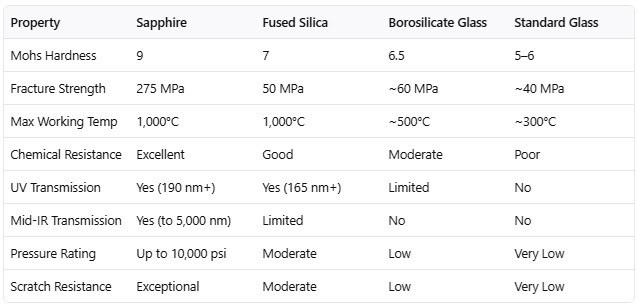
Fused silica performs well in UV applications and offers excellent thermal stability due to its near-zero thermal expansion. But it fractures at a fraction of sapphire’s load and offers much less chemical resistance in abrasive or reactive environments. When the application demands both optical quality and extreme mechanical performance, sapphire wins.
Downhole instrumentation operates in some of the most demanding environments on earth. Pressures exceed thousands of psi. Temperatures climb well above 200°C. Hydrogen sulfide and brine attack conventional materials within months. Sapphire optical windows enable reliable optical access for downhole pressure sensors, fluid sampling systems, and flow monitoring equipment in these brutal conditions.
On the surface side, sapphire sight glasses provide visual and optical access to high-pressure pipelines and process vessels containing corrosive hydrocarbons, sour gas, and chemical treatment fluids. Their combination of hardness, chemical resistance, pressure capability, and optical clarity allows them to maintain performance in environments where standard glass sight glasses may be vulnerable to chemical etching, abrasion, clouding, or mechanical fracture.Aerospace and Defense: Protecting Sensors at Extreme Speeds
Sapphire optical windows protect missile guidance sensors, drone imaging systems, and hypersonic aircraft optical ports against the extreme thermal and mechanical loads generated at high speed. According to Military Aerospace and Electronics, sapphire windows are used to protect sensors and cameras from sand and other high-speed particulates on aircraft and weapons operating in harsh environments.
The combination of erosion resistance, UV-to-IR transparency, and structural toughness makes sapphire the preferred window material for:
Researchers studying combustion dynamics, flame propagation, and chemical reaction kinetics need optical access into high-pressure, high-temperature combustion chambers and reactors. Sapphire optical windows provide that access without contaminating the measurement or failing under the thermal and mechanical loads involved.
As documented in combustion research applications, sapphire windows, including designs up to 10 mm thick, successfully provide optical access for high-speed cameras and infrared imaging systems in combustion chamber test rigs operating at elevated pressures and flame temperatures. The windows survive repeated thermal cycling while maintaining the surface quality needed for accurate optical measurements.
Sapphire’s biocompatibility, chemical inertness, and optical transparency make it valuable in endoscopic imaging systems, high-pressure autoclave viewports, and analytical chemistry instruments. Spectroscopic instruments that need to analyze samples under pressure, temperature, or in chemically reactive environments rely on sapphire windows to maintain measurement integrity. With appropriate antireflection coatings, sapphire windows can achieve very high (up to 99%) transmission in targeted wavelength bands, including UV, visible, NIR, or mid-IR ranges depending on the coating design.
Selecting the right sapphire optical window starts with answering four questions:
What pressure will the window face? Window thickness depends on the unsupported aperture diameter, pressure differential, mounting design, material strength, and required safety factor. For pressure-bearing optical windows, engineers commonly specify a safety factor around 3 to 5, or higher for critical applications, so the window rating should be comfortably above the maximum operating pressure.
What wavelengths need to transmit? Sapphire offers broad transmission from the UV through the visible and into the mid-IR, often cited at approximately 0.15 to 5.5 µm depending on grade, thickness, and transmission requirement. C-axis sapphire is often preferred when low birefringence along the optical path is important. If UV performance is critical, confirm the specific transmission curve for your wavelength range.
What chemical environment will the window contact? Sapphire is compatible with most industrial acids, alkalis, solvents, salts, process gases, and corrosive environments. However, compatibility should be confirmed for aggressive conditions such as hydrofluoric acid, highly concentrated hot caustics, molten salts, or plasma/etch environments.
What surface quality and flatness do you need? Standard sapphire windows offer 40-20 scratch-dig surface quality. Precision laser and spectroscopic applications may require 20-10 surface finish and flatness to 0.5 fringes of HeNe light.
Properly engineered sapphire optical window assemblies can handle up to 10,000 psi, depending on the window diameter, thickness, mounting design, sealing method, operating temperature, and applied safety factor. In general, thicker windows with smaller clear apertures can handle higher pressures. Engineers typically design with a safety factor of 3 to 5 for critical applications.
Sapphire transmits light from approximately 190 nm in the UV through 5,000 nm in the mid-infrared. Uncoated windows achieve up to 85% transmission. Anti-reflection coated windows achieve up to 99% in targeted wavelength bands. This broad spectrum covers UV spectroscopy, visible imaging, near-IR sensing, and mid-IR thermal analysis.
Sapphire has a fracture strength of 275 MPa versus approximately 40 to 60 MPa for glass. It resists acids and alkalis that etch glass surfaces. It maintains structural integrity at temperatures up to 1,000°C where glass would soften and fail. And it can be made up to 65% thinner than glass at equivalent structural ratings, improving optical performance in precision systems.
Sapphire handles moderate thermal shock well. Its thermal conductivity of ~42 W/m·K dissipates heat rapidly, reducing the temperature gradient that causes thermal shock fractures in lower-conductivity materials. For applications involving sudden extreme temperature changes, gradual transition profiles, proper mounting design, and active cooling systems minimize risk further.
Yes. Sapphire is highly resistant to hydrogen sulfide, brine, hydrocarbons, and most sour gas components encountered in oil and gas production. This makes sapphire optical windows a standard choice for downhole sensing, surface process vessels, and wellhead monitoring equipment operating in H₂S service.
The primary industries are oil and gas (downhole and surface process monitoring), aerospace and defense (sensor protection at extreme speeds), combustion and chemical research (optical access to high-pressure reactors), and medical/scientific instrumentation (spectroscopy and analytical chemistry). Each relies on a different combination of sapphire’s hardness, chemical resistance, optical transmission, and temperature performance.
Standard industrial sapphire windows use 40-20 scratch-dig surface quality. Precision optical applications requiring minimal scatter and high wavefront quality specify 20-10 surface finish with flatness to 0.5 fringes of HeNe light. Anti-reflection coatings improve transmission and reduce ghost reflections in sensitive imaging and spectroscopy systems.
When your application puts conventional window materials to the test and they fail, the answer isn’t to find better glass. It’s to specify the right material from the start. AdValue Technology supplies high-purity sapphire optical windows and components engineered for the most demanding research and production environments in advanced manufacturing.
Whether you need standard flat sapphire windows for optical communication packages, custom-dimensioned viewports for high-pressure process equipment, or precision laser-machined sapphire components with tight surface quality specifications, AdValue Technology brings the materials expertise, custom machining capabilities, and fast delivery you need to keep your project moving. Their laser machining services handle sapphire’s extreme hardness with precision cutting, drilling, scribing, and marking to exact customer specifications.Your optical system deserves a window that can take whatever your environment throws at it. Contact AdValue Technology today to discuss your sapphire optical window requirements and find the specification that matches your exact application.