No products in the cart.
Quartz sand is one of the most abundant minerals on Earth, yet very few materials in modern industry are as carefully specified or as demanding to source correctly. From the semiconductor chips inside your smartphone to the fiber optic cables carrying internet data across continents, quartz sand sits at the foundation of technologies most people never think about.
The challenge isn’t finding quartz sand. It’s finding the right grade, at the right purity, with the right particle size for a given application. Get that wrong and the consequences ripple downstream through entire manufacturing processes. This guide covers the key industrial applications that depend on quartz sand, explains what separates standard grades from high purity materials, and helps you understand what to specify for your process.
Quartz sand is crystalline silicon dioxide (SiO₂), and its value to industry comes from a combination of properties that very few other minerals can match. It’s hard. It’s chemically inert. It withstands high temperatures. And when refined to high purity levels, it transmits light across ultraviolet, visible, and infrared wavelengths with exceptional clarity.
That combination makes quartz sand an essential material across dozens of industrial sectors, from bulk construction materials to precision semiconductor fabrication environments.
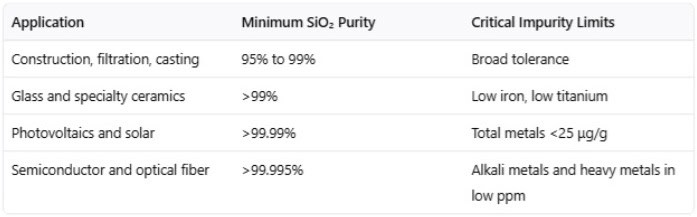
These properties aren’t just useful. In many industrial processes, they’re non-negotiable. A refractory application needs thermal stability. A fiber optic preform needs the optical transmission. A semiconductor crucible needs both, along with ultra-low impurity levels. According to the Essential Minerals Association, quartz is the second most common mineral on Earth’s surface, yet the highest-purity grades suited to advanced manufacturing remain genuinely scarce and strategically important.
Standard quartz sand works well for construction, filtration, and casting. High purity quartz sand is a different product category entirely. The distinction lies in how tightly impurity content is controlled, specifically iron, aluminum, titanium, and alkali metals, each of which can degrade performance in sensitive applications.
AdValue Technology supplies high purity quartz sand at 99.99% (SD-990) and greater than 99.995% (SD-995) purity grades, with particle sizes from micron powders to coarse granular material.
Semiconductors are one of the largest consumers of high-purity quartz globally, reflecting how deeply silicon chip fabrication depends on quartz-based components at nearly every stage of the manufacturing process.
The reason is straightforward. Semiconductor fabrication involves extreme temperatures, aggressive chemicals, and contamination tolerances measured in parts per billion. Quartz components offer the thermal stability, chemical resistance, and purity needed to keep those environments clean and controlled.
Single-crystal silicon ingots, the starting material for virtually every silicon wafer produced today, grow inside quartz crucibles using the Czochralski (CZ) process. In this process, a seed crystal contacts molten silicon at temperatures above 1,400°C and slowly pulls a cylindrical ingot from the melt. The quartz crucible holds that molten silicon throughout the entire process.
Quartz is the industry standard material for this application. It tolerates the necessary temperatures, resists contamination from the molten silicon, and doesn’t introduce metallic impurities that would compromise wafer quality. The purity of the quartz crucible directly affects the purity of every wafer grown inside it, and wafer purity determines whether the finished chips function correctly.
Beyond crucibles, quartz components appear throughout wafer fabrication in roles you might not expect:
Every one of these components demands quartz sand feedstock with minimal alkali metal and heavy metal contamination. A single out-of-spec batch can affect yield across an entire production run.
By volume, glass manufacturing consumes more quartz sand than any other industry. Silica sand accounts for roughly 70% to 75% of all raw materials in standard glass production, and the specific grade required varies considerably depending on the glass type.
Flat glass for buildings and automotive applications, container glass for food and beverages, and specialty glass for scientific instruments all rely on quartz sand as the primary raw material. The purity requirements differ, but the fundamental role of SiO₂ as the primary glass-forming oxide stays constant.
For standard flat glass and container glass, SiO₂ content ~98-99+% is typical. For ultra-clear glass, optical glass, and specialty scientific glass, purity requirements rise sharply. Iron oxide content becomes critical because even trace amounts create a green tint that affects both appearance and optical performance.
Specialty glass categories that depend on high purity quartz sand include:
The solar energy industry relies on quartz sand at multiple points in the production chain. First, photovoltaic cover glass requires high purity quartz sand to achieve the low iron content needed for maximum light transmittance. Second, the silicon used in solar cells themselves originates from high purity quartz feedstock.
Quartz crucibles made from high purity sand are essential for producing both monocrystalline and polycrystalline silicon used in photovoltaic modules. These processes require stringent control of impurities, as trace contaminants can affect crystal quality, carrier lifetime, and overall cell efficiency.
Modern telecommunications infrastructure runs on silica optical fibers. These fibers transmit data as pulses of light across thousands of kilometers with minimal signal loss. Achieving that performance requires quartz sand purity at levels that far exceed what glass manufacturing typically demands.
Optical fiber production uses ultra-high purity silica, typically derived from refined quartz feedstock and converted into synthetic fused silica for preform fabrication The preform is then drawn into hair-thin strands. The entire optical performance of the finished fiber, including how far a signal travels before degradation, depends on the homogeneity and purity of the original quartz material.
Impurities in the quartz feedstock translate directly into light scattering and signal attenuation in the finished fiber. Trace metallica impurities, hydroxyl groups, and and structural defects all increase optical loss. For long-distance communication fibers, even small increases in attenuation significantly reduce transmission range and require more signal amplification infrastructure.
High purity silica optical fibers offer:
Refractory materials made from high purity quartz sand withstand the extreme temperatures inside furnaces, kilns, and reactors across the metals, ceramics, and chemical industries. Silica bricks used in steel-making furnaces require SiO₂ content above 97%, while more demanding applications in aluminum smelting and specialty ceramics push purity requirements considerably higher.
In advanced ceramics, silica (often derived from quartz) is used as a raw material or additive in selected formulations, where it can contribute to dimensional stability, thermal behavior, and glass phase formation during sintering. Applications include structural ceramics, thermal insulation materials, and certain high-temperature components used in industrial and aerospace environments.
Natural quartz sand accounts for a large share of all proppants used in hydraulic fracturing operations. In this application, precisely sized and rounded quartz grains are pumped deep into rock formations under high pressure. Once the pressure releases, the sand grains prop open the fractures, allowing oil and gas to flow to the surface.
The hardness of quartz (Mohs 7) and its compressive strength make it ideal for withstanding the crushing pressures found thousands of feet underground. Particle size, sphericity, and crush resistance are the key quality indicators for hydraulic fracturing sand, with tighter specifications commanding significant price premiums in the market.
Granular quartz sand has served as a filtration medium in water treatment for more than a century. Its chemical inertness means it doesn’t react with the water or contaminants passing through it. Its hardness prevents breakdown and bed degradation over time. And its particle size uniformity enables predictable filtration performance.
Municipal water treatment plants, industrial process water systems, and swimming pool filtration all use quartz sand as a primary filtration layer. The Essential Minerals Association identifies water filtration as one of the most stable, consistently high-volume markets for industrial quartz sand.
Quartz sand feeds a broad range of chemical synthesis processes. High-temperature melting of quartz sand with alkali produces sodium silicate and potassium silicate, which find use in detergents, adhesives, and coatings. Silicon tetrachloride and silicon dioxide derived from quartz sand feedstocks serve as precursors for silicone polymers, specialty coatings, and pharmaceutical excipients.
Silicon carbide, one of the hardest abrasive materials available, is also produced from quartz sand through a high-temperature reaction with carbon. The purity of the quartz sand feedstock affects the purity and consistency of the final silicon carbide product.
Choosing the right quartz sand grade starts with identifying your application’s tolerance for specific impurities. Ask yourself:
Purity alone doesn’t determine whether quartz sand performs in your process. Particle size and distribution are equally important. Coarser granular grades suit filtration beds and casting molds. Fine powders and submicron grades are required for slurry-based processing, optical coatings, and ceramic formulations.
Always specify both D50 and D90 particle size values when ordering. A narrow size distribution often matters more than the median particle size alone, particularly in filtration, semiconductor slurries, and precision ceramic forming operations.
What industries use the most quartz sand? Glass manufacturing consumes the largest volume of quartz sand by far, followed by construction, foundry casting, and oil and gas. By value, the semiconductor and optical fiber industries consume the most high purity quartz sand due to their strict purity requirements and high cost-per-unit feedstock.
What is the difference between silica sand and quartz sand? The terms are often used interchangeably, but quartz sand specifically refers to sand dominated by crystalline SiO₂. Silica sand is a broader category that may include other silica mineral forms. High purity quartz sand for industrial applications is specifically sourced and processed to maximize SiO₂ content and minimize metallic impurities.
Why does quartz sand purity matter so much in semiconductor manufacturing? Semiconductor fabrication involves temperatures above 1,400°C and contamination tolerances in the parts per billion range. Impurities in quartz components migrate into silicon melts and wafer surfaces, creating defects that reduce chip performance and yield. Ultra-high purity quartz is the only material that meets the cleanliness and thermal stability requirements of this environment.
What particle size of quartz sand is used in hydraulic fracturing? Hydraulic fracturing proppants typically use quartz sand in the 0.1 mm to 0.85 mm size range, corresponding to common mesh sizes such as 20/40, 30/50, 40/70, and 70/140. The specific size is selected based on the target formation’s fracture geometry and closure pressure. Roundness and sphericity are also critical quality factors alongside particle size.
Can quartz sand be used in additive manufacturing? Yes. High purity quartz sand finds growing use in binder jetting for sands molds and cores, as well as in slurry-based or indirect methods for producing silica-containing ceramic components. Fine grades with controlled particle size distribution enable precise layer deposition and consistent sintering behavior in 3D-printed ceramic components.
What is fused quartz and how does it differ from quartz sand? Fused quartz is amorphous (non-crystalline) silicon dioxide produced by melting high purity quartz sand or quartz crystals at extremely high temperatures. The fused form offers even lower thermal expansion and higher optical transmission than crystalline quartz, making it ideal for precision optical components, semiconductor equipment, and laboratory ware.
What purity level does solar-grade quartz sand require? Solar photovoltaic applications require quartz sand with SiO₂ content of at least 99.99% and tightly controlled levels of metallic impurities. These requirements apply to quartz crucibles used in silicon ingot growth, where any metallic contamination directly degrades solar cell efficiency.
How is quartz sand used in water filtration? Quartz sand acts as a mechanical filtration medium in water treatment systems. Water passes through a bed of graded quartz particles that physically trap suspended solids, sediment, and particulates. The chemical inertness of quartz ensures it doesn’t contaminate the water or degrade over time in contact with treatment chemicals.
What makes quartz sand suitable for optical fiber production? Optical fiber requires a feedstock with extremely low hydroxyl content, minimal metallic impurities, and exceptional chemical homogeneity. High-purity silica—often derived from refined quartz feedstock and further processed into synthetic fused silica—achieves the optical transparency and low attenuation coefficients needed for long-distance light transmission. Any impurity that scatters or absorbs light increases signal loss and reduces the practical range of the fiber.
Is quartz sand the same as silicon? No. Quartz sand is silicon dioxide (SiO₂), a compound of silicon and oxygen. Pure silicon (Si) is a metallic element produced by reducing SiO₂ through high-temperature processing with carbon. High purity quartz sand is the primary feedstock for producing the silicon used in semiconductors, solar cells, and silicone polymers.
The industrial applications covered here share one common requirement: the quartz sand going into the process has to be right. Purity, particle size, and batch consistency aren’t negotiable when you’re producing semiconductor wafers, optical fibers, or solar-grade silicon.
AdValue Technology has supplied high purity specialty materials to engineers, scientists, and manufacturers for more than 20 years. Their high purity quartz sand is available in two primary grades:
Particle sizes range from micron powders to coarse granular material, with custom grades and particle size distributions available on request. Certificates of Analysis are available, and both small research quantities (250g, 500g) and bulk orders are supported.
AdValue Technology also supplies fused quartz products including crucibles, tubing, rods, boats, and custom quartz ware for semiconductor, optical, and laboratory applications, manufactured from the same high purity feedstock.Ready to source high purity quartz sand for your application? Visit AdValue Technology’s quartz sand product page or contact the team at sa***@*********ch.com to discuss your specifications.