No products in the cart.
Run a high-temperature process with the wrong powder and you’re gambling with every cycle. Contaminants don’t stay quietly in place when temperatures climb past 1000°C. They migrate, react, and destabilize. Parts fail. Yields drop. Data becomes unreliable. For engineers, scientists, and manufacturers who depend on precision at extreme temperatures, the purity of your starting powder isn’t a footnote in the spec sheet. It’s the foundation everything else is built on.
This guide breaks down exactly why high purity powders matter in high-temperature processing, how impurities cause damage you might not see coming, and how to choose the right material for your specific application.
The word “pure” gets thrown around loosely in materials supply. But in high-temperature processing, purity has a precise, quantified meaning. It’s not subjective. It’s measured, graded, and directly tied to how a material behaves under thermal stress.
High purity powders start at 99.9% purity and go higher from there. At that level, only 0.1% of the material consists of anything other than the primary compound. That sounds negligible until you realize how much damage even trace amounts of the wrong element can cause inside a furnace running at 1500°C or higher.
The “N” notation is the universal shorthand for powder purity grades. Each “N” represents a nine in the purity percentage. Here’s how it breaks down:
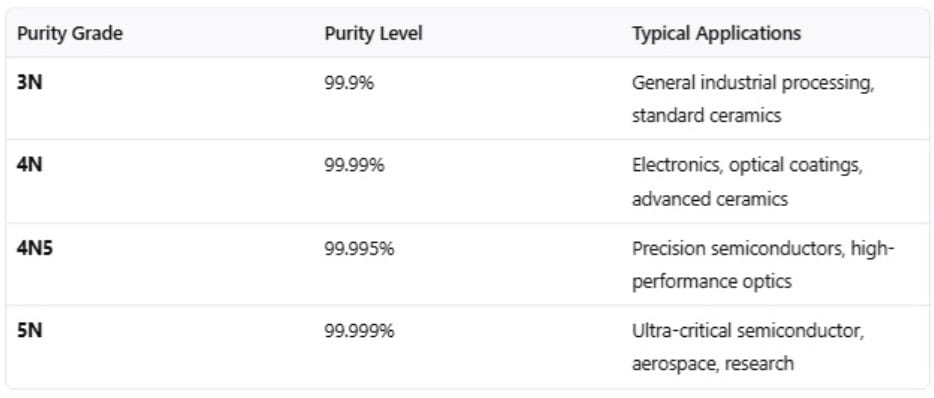
Each step up in purity reduces the total impurity content by a factor of ten. Going from 3N to 5N doesn’t sound like a big jump numerically but in a high-temperature furnace, those extra nines translate directly into structural stability, thermal performance, and product reliability.
AdValue Technology supplies powders ranging from 99.9% (3N) to 99.999% (5N), with particle sizes adjustable to fit both research and production-scale requirements.
Commodity powders typically land in the 90% to 98% purity range. For bulk industrial tasks where precision doesn’t matter much, that’s fine. But the moment you push those powders into high-temperature environments, the limitations show up fast.
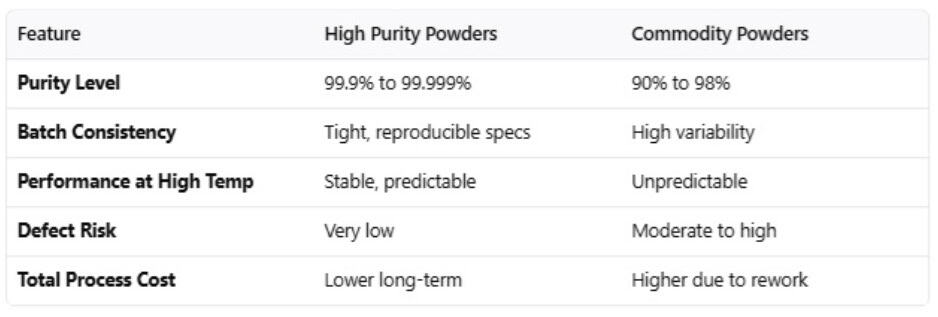
High purity powders cost more upfront. That’s real. But the true cost comparison shifts dramatically when you factor in defect rates, rework, part rejection, and process downtime caused by impurity-driven failures.
Impurities don’t announce themselves. You won’t see them in the powder. But once temperatures rise, they become active participants in your process, and rarely in helpful ways.
At elevated temperatures, trace contaminants introduce internal stresses into the material structure. These stresses don’t just weaken parts. They create micro-fractures, localized deformation, and crack propagation pathways that wouldn’t exist in a high-purity material.
Consider sintering operations. When you sinter ceramics or metal powders at high temperatures, you’re counting on the particles to bond cleanly and uniformly. Impurity particles disrupt that uniformity. They can:
Research published in ScienceDirect on powder sintering behavior confirms that powder characteristics, including impurity content, directly and significantly influence sintering behavior and the microstructural quality of the final product. That’s not a fringe finding. It’s a well-documented effect across ceramic and metal powder science.
Some impurities don’t just weaken structure. They can fundamentally alter its phase composition and stability. Certain trace elements act as fluxing agents at high temperatures, lowering the effective melting point of local regions and causing unintended phase transitions.
In alumina processing, for example, iron oxide impurities can promote liquid-phase formation, accelerate grain growth, and alter densification behavior. In boron nitride systems, metallic impurities can increase electrical conductivity, reduce oxidation resistance, and compromise dielectric performance at high temperatures. These are well-understood and predictable outcomes when impurity levels exceed what is appropriate for high-temperature applications.
Thermodynamic research also shows that impurities can shift phase diagram boundaries, meaning the temperatures at which your material transitions from one phase to another are no longer where you expect them to be. That alone can invalidate process parameters you’ve spent months optimizing.
High-temperature processing touches more industries than most people realize. And in each of them, purity isn’t just preferred. It’s required.
Semiconductor fabrication operates at temperatures where even parts-per-million contamination levels matter. High purity alumina powder is used in semiconductor packaging, substrate manufacturing, and certain thermal interface materials. Trace metals in these applications don’t just degrade performance. They can introduce leakage paths, increase unintended conductivity, and ultimately lead to short circuits or device failure.Sapphire substrates used in LED production, for instance, require ultra-high purity alumina (typically 5N grade) as the starting material. Any impurities in the feedstock show up as defects in the crystal structure, directly reducing LED output efficiency and operational lifespan.
Aerospace components face some of the most extreme thermal cycles of any engineered system. Turbine blades, thermal barrier coatings, and heat shields must withstand rapid temperature changes, high stresses, and aggressive environments. Many of these systems—particularly coatings and ceramic components—depend on high-purity powder feedstocks to achieve the mechanical strength, dimensional stability, and thermal resistance required for flight.In thermal spray coatings, the purity of the powder feedstock directly determines coating density, bond strength, and resistance to thermal fatigue. Introducing impurities into these coatings can introduce weak interfaces, promote oxidation, and disrupt microstructural uniformity, initiating failure mechanisms such as delamination and reduced service life. There’s no margin for error when the application is an aircraft engine or a hypersonic vehicle.
Advanced ceramics are one of the most demanding environments for powder purity requirements. Whether you’re producing cutting tools, wear-resistant components, or high-temperature structural parts, the sintering process significantly amplifies the effects of impurities present in your starting material.
Boron nitride powder is a strong example here. At temperatures approaching 2000°C, BN ceramics rely on extremely low metallic impurity levels to maintain their characteristic combination of high thermal conductivity and excellent electrical insulation. Metallic contaminants can increase electrical conductivity, promote oxidation, and disrupt microstructural stability at elevated temperatures. AdValue Technology’s boron nitride powders are processed at temperatures up to 2000°C and engineered with strict metallic impurity controls to meet these demands.
Lithium-ion battery systems are acutely sensitive to trace metal contamination. High purity alumina is used as a ceramic separator coating that must withstand thermal cycling while maintaining electrochemical stability. Even tiny amounts of iron, copper, or other metallic impurities can promote localized lithium deposition, trigger dendrite growth, degrade electrolyte performance, and create internal short circuit risk. Clean powder inputs aren’t optional here. They’re essential to ensuring both safety and performance.
Not every powder is created equal, and not every powder suits every high-temperature application. Here’s a look at the most important materials and what makes them effective.
Alumina (Al₂O₃) is the workhorse of high-temperature ceramic materials. Its melting point of approximately 2050°C, hardness of 9 on the Mohs scale, and excellent chemical resistance make it a top choice across a wide range of demanding applications.
For high-temperature processing, alpha alumina (α-Al₂O₃) is the preferred phase. Its dense hexagonal crystal structure provides superior thermal and mechanical stability compared to other alumina phases. At purity levels of 99.99% and above, alpha alumina delivers consistent sintering behavior, predictable grain growth, and minimal contamination risk for sensitive downstream processes.
AdValue Technology offers alumina in grades from 99.99% (4N) through to 99.999% (5N), with particle sizes ranging from sub-micron to 500 microns to fit specific processing needs.
Boron nitride (BN) is one of the most thermally stable compounds available for high-temperature applications. It maintains electrical insulation properties at temperatures where most materials fail, and its layered crystal structure provides natural lubrication that makes it useful as a solid lubricant, mold release agent, and anti-oxidation additive in high-temperature metal processing.
BN powder is also the precursor to cubic boron nitride (CBN), one of the hardest materials known, used extensively in cutting tools and superabrasives. The purity of the hexagonal BN starting powder directly affects the quality of CBN produced.
Key properties of high purity BN for high-temperature use:
Beyond alumina and boron nitride, several other high purity powders play important roles in high-temperature processing:
Getting purity right is step one. But choosing the right powder for your specific high-temperature application takes more than picking the highest purity grade available.
Not every application needs 5N purity and specifying it when 4N would do is just an unnecessary cost. Work through these questions when selecting your purity grade:
For semiconductor and precision optical applications, 4N5 or 5N is typically the minimum standard. For advanced ceramic sintering and aerospace thermal coatings, 4N to 4N5 often balances performance and cost effectively. General high-temperature processing and research applications may be well-served by 3N to 4N grades, depending on the specific reaction environment.
Purity and particle size are equally important levers in high-temperature powder performance. Finer particles offer:
Coarser particles offer:
The right particle size depends entirely on your process parameters, equipment, and end-use requirements. Always verify particle size distribution specifications, not just a single D50 value, when comparing powder grades from different suppliers.
What purity level do I need for high-temperature ceramic sintering? Purity requirements depend strongly on the material system and application. For many advanced ceramic sintering operations, purity levels in the 99.9% (3N) range are sufficient for general structural applications. Applications involving semiconductor substrates, precision optics, or reactive atmospheres typically require 4N5 or 5N grades to prevent contamination-driven defects.
How do impurities affect powder behavior at high temperatures? Impurities can lower the effective melting point of localized material regions, trigger unintended phase transitions, disrupt grain boundary formation during sintering, and create stress concentrations that lead to cracking and mechanical failure. The higher the temperature, the more mobile and reactive those impurities become.
What is the difference between 3N and 5N purity powders? A 3N powder is 99.9% pure, meaning it contains up to 0.1% impurities. A 5N powder is 99.999% pure, with impurities limited to just 0.001%. That 100-fold reduction in impurity content makes a significant difference in applications where trace contamination directly impacts performance, reliability, or safety.
What is alpha alumina and why is it preferred for high-temperature processing? Alpha alumina (α-Al₂O₃) is the most thermally stable crystalline phase of aluminum oxide, with a melting point of around 2050°C. Its dense hexagonal structure resists phase transitions under thermal stress, making it far more reliable in high-temperature environments than metastable phases like gamma alumina.
Can high purity boron nitride be used as a lubricant in high-temperature metal processing? Yes. Hexagonal boron nitride’s layered crystal structure gives it natural solid lubricant properties that remain effective at temperatures far beyond the range of conventional lubricants. It’s used extensively as a mold release agent, anti-sticking additive, and die lubricant in metal forming and processing operations at elevated temperatures.
How does powder purity affect semiconductor manufacturing? In semiconductor fabrication, trace metallic impurities in powder feedstocks can compromise conductivity, create charge traps, reduce device reliability, and cause catastrophic failure in finished components. Ultra-high purity powders (4N to 5N) are often required for materials used in semiconductor processing environments, with impurity limits tightly controlled based on the specific application and sensitivity to contaminants.
Does particle size affect high-temperature sintering performance? Absolutely. Finer particles sinter faster and at lower temperatures due to their higher surface area and increased atomic mobility. Coarser particles offer better handling characteristics and more controlled grain growth. Matching particle size to your sintering profile is just as important as selecting the correct purity grade.
What industries rely most on high purity powders for high-temperature applications? Semiconductor manufacturing, aerospace engineering, advanced ceramics production, energy storage systems, optical fabrication, and research laboratories all depend heavily on high purity powder feedstocks for high-temperature processing applications.
Are high purity powders more expensive than standard grades? Yes, high purity powders carry a higher upfront cost. However, when you account for reduced defect rates, lower rejection rates, fewer processing failures, and avoided rework costs, high purity powders frequently deliver lower total process costs, particularly in high-value applications.
How should high purity powders be stored to maintain their integrity? Store high purity powders in airtight containers in a dry, temperature-controlled environment. Exposure to moisture, airborne contaminants, and incompatible materials can degrade purity levels before the powder ever reaches your process. Always handle with clean tools and follow manufacturer storage guidelines.
Your high-temperature process is only as reliable as the materials going into it. AdValue Technology has spent more than 20 years supplying engineers, scientists, and manufacturers worldwide with high purity and ultra-high purity powders engineered for demanding processing environments.
Their powder portfolio includes:
Every powder AdValue Technology offers comes with strict purity specifications, controlled particle size distributions, and batch-to-batch consistency built for research-scale precision and production-scale reliability. Whether you need small quantities for R&D or bulk supply for a manufacturing operation, their team can match the right purity grade and particle size to your process requirements.Don’t let impurities compromise your next high-temperature process. Visit AdValue Technology to explore the full high purity powder catalog, or contact their team at sa***@*********ch.com to discuss your specific material requirements.