No products in the cart.
Pick the wrong abrasive powder and you’ll spend hours redoing work, scrapping parts, or chasing defects that shouldn’t exist. Pick the right one and your surfaces come out clean, smooth, and exactly on spec. For engineers, scientists, and manufacturers who rely on precision finishing, understanding the differences between alumina powders, cerium oxide powders, and diamond powders isn’t optional. It’s essential.
This guide breaks down everything you need to know about these three leading abrasive powders, including their properties, best-fit applications, and how to choose between them.
Surface finishing sounds simple, but it’s anything but. Whether you’re lapping a semiconductor wafer, polishing optical glass, or grinding a high-hardness ceramic, the abrasive powder you select directly determines your surface quality, material removal rate, and overall process efficiency.
Not all abrasive powders are created equal. Some rely purely on mechanical action, cutting through material with brute hardness. Others combine chemical reactivity with mild abrasion to deliver ultra-smooth finishes that purely mechanical abrasives can’t match. The right choice depends on what you’re polishing, what finish you need, and what your budget allows.
Abrasive powders are central to industries ranging from semiconductors and optics to aerospace and medical device manufacturing. Getting this decision right saves time, reduces defect rates, and protects the integrity of high-value parts.
Alumina, or aluminum oxide (Al₂O₃), has earned its reputation as one of the most widely used abrasive powders across industries. It’s hard, chemically stable, and cost-effective. For applications that demand consistent cutting action without the premium price tag of diamond or cerium oxide, alumina delivers.
Alumina’s strength comes from its combination of hardness and chemical inertness. Here’s a snapshot of what makes it stand out:
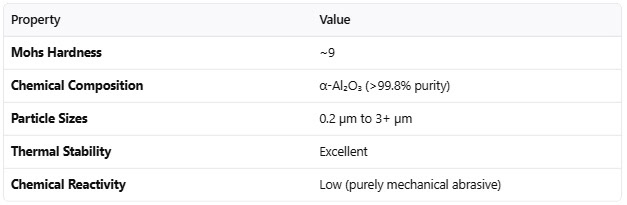
With a hardness of 9 on the Mohs scale, alumina is among the hardest oxide materials, surpassed only by diamond and a few superhard materials. This enables effective grinding and polishing of metals, ceramics, and glass effectively. Because it doesn’t react chemically with most substrates, it works reliably across a wide range of materials with low contamination risk.
High-purity alpha alumina (α-Al₂O₃) is the preferred choice for precision applications. Refined grades with >99.8% Al₂O₃ minimize impurities that could introduce scratches or discoloration on sensitive surfaces.
Alumina shines in applications where a balance of cutting efficiency and cost matters more than achieving an optical-grade finish. Common use cases include:
One thing to keep in mind is that alumina is primarily a mechanical abrasive, with minimal chemical interaction during processing. As a result, excessive pressure or improper particle sizing can lead to micro-scratches or subsurface damage. It works best during rough-to-intermediate finishing stages, not final optical polishing. Selecting the right alumina particle size for each stage of lapping is critical to surface quality outcomes.
Cerium oxide (CeO₂) occupies a unique position in the abrasive world. It’s softer than alumina with a Mohs hardness of around 6, yet it consistently outperforms harder abrasives in optical and glass polishing applications. How? Because it doesn’t just grind. It reacts.
Cerium oxide works through a dual chemical-mechanical polishing mechanism that sets it apart from conventional abrasives. Mechanically, the particles remove surface irregularities just like any other abrasive. But chemically, the Ce³⁺/Ce⁴⁺ redox couple facilitates interaction with the glass or oxide surface to form a transient, softened surface layer. That layer is more easily removed during polishing, enabling smoother material removal and significantly reducing micro-scratches and subsurface damage.
This chemical-mechanical action is why cerium oxide is the preferred abrasive for optical glass, oxide-based CMP, and precision surfaces where scratch-free finishes are non-negotiable.
Key properties at a glance:
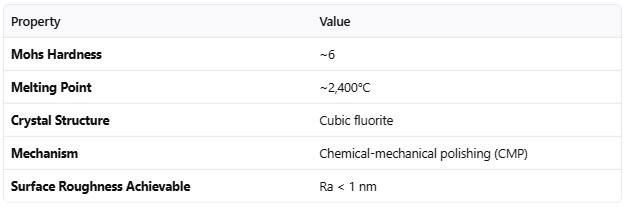
Cerium oxide’s versatility makes it a go-to abrasive across several demanding industries:
Cerium oxide also consistently outperforms aluminum oxide for transparent materials. It virtually eliminates deep scratches and achieves optical-grade surfaces that are impossible to replicate with purely mechanical abrasives. You can explore more on this from AdValue Technology’s guide on cerium dioxide applications.
If alumina is the workhorse and cerium oxide is the precision finisher, diamond powder is the specialist you bring in when nothing else can handle the job. At a perfect 10 on the Mohs hardness scale, diamond is the hardest known abrasive material on the planet. It cuts faster, lasts longer, and works on materials that would simply shrug off softer abrasives.
Not all diamond powder is the same. The two main types each bring different characteristics to the table:
Monocrystalline Diamond Powder
Polycrystalline Diamond Powder
Diamond powder is also available across a broad range of particle sizes, from 150 µm for rough grinding down to 0.1 µm for final mirror-finish polishing.
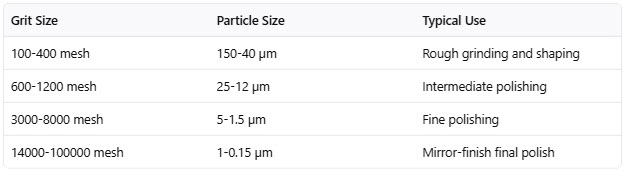
Diamond powder’s extreme hardness makes it the only viable abrasive for many high-performance applications:
Diamond powder does cost significantly more than alumina or cerium oxide. But for high-value parts where tolerances are tight and defects are unacceptable, that cost is easily justified by superior yield and reduced rework. Its superior cutting efficiency, extended tool life, and reduced defect rates can substantially improve overall process yield and lower total cost of ownership.
Here’s a clear side-by-side breakdown to help you quickly evaluate your options:
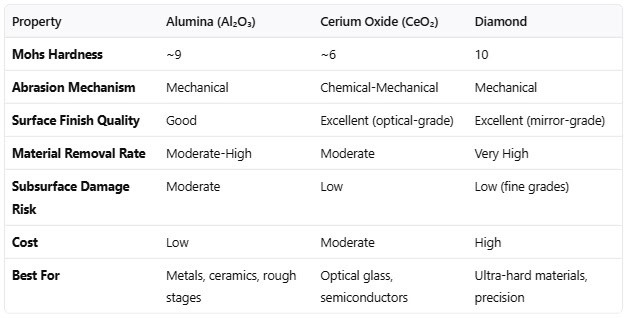
Picking the right abrasive powder isn’t just about hardness. You need to think through your full process from start to finish.
1. Substrate Material Hardness Match your abrasive hardness to your substrate. Using diamond on soft optical glass is overkill and risks damage. Alumina on ultra-hard ceramics won’t get the job done efficiently.
2. Required Surface Finish If you need ultra-smooth surfaces (e.g., Ra < 1 nm for an optical application), cerium oxide or fine diamond powder is your answer. For rough grinding stages, alumina works well and costs less.
3. Particle Size Distribution Tighter particle size distributions deliver more consistent finishes. Broad distributions create uneven cutting and can introduce scratches. Always confirm particle size specs before ordering.
4. Purity Level High-purity powders matter more than many engineers realize. Trace impurities can contaminate sensitive substrates, leave staining, or create surface defects that require rework. For semiconductor and optical applications, always specify high-purity grades.
5. Process Chemistry If you’re running a CMP process, consider how your abrasive interacts with your slurry chemistry, pH levels, and polishing pad. Cerium oxide plays particularly well with CMP slurry formulations designed for glass and oxide surfaces.
6. Cost-Per-Part Economics Diamond costs more upfront but often reduces total process cost through faster removal rates, longer abrasive life, and higher yield on expensive parts. Run the full cost analysis before defaulting to the cheapest option.
What is the hardest abrasive powder available? Diamond powder is the hardest abrasive powder available, scoring a perfect 10 on the Mohs hardness scale. Nothing cuts harder or lasts longer in precision grinding and polishing applications.
When should I use cerium oxide instead of alumina? Use cerium oxide when you need optical-grade surface finishes on glass, semiconductor wafers, or transparent materials. Cerium oxide’s chemical-mechanical action delivers far smoother results on these substrates than alumina can achieve.
What particle size of alumina powder do I need for polishing? The appropriate particle size depends on the stage of your process and the required surface finish. For final polishing, 0.1 to 0.3 µm alumina is standard. Medium finishing work typically uses 0.5 to 1.0 µm. Rough stock removal can use particles in the 1 to 5 µm range. Always work through progressively finer particle sizes to achieve the best finish.
Can I use diamond powder for glass polishing? You can, but it’s often not the optimal choice for final finishing. Diamond is highly effective for grinding and pre-polishing stages, where fast material removal is required. For final polishing, Cerium oxide’s chemical-mechanical interaction with glass surfaces typically produces smoother, defect-free finishes. Diamond powder is better reserved for ultra-hard materials like ceramics, carbides, and sapphire.
What is CMP and which abrasive powders are used in it? CMP stands for chemical-mechanical planarization. It’s the process used to polish semiconductor wafers and dielectric layers to atomic-level flatness. Common abrasive materials used in CMP include:
Diamond abrasives are generally not used in CMP. Instead, they are used in earlier steps such as lapping and grinding.
Is monocrystalline or polycrystalline diamond powder better? It depends on your application. Monocrystalline diamond cuts aggressively and suits hard materials such as ceramic and carbide grinding. Polycrystalline diamond fractures during use to expose fresh cutting edges, making it better for fine polishing on sensitive materials.
How does purity affect abrasive powder performance? Higher purity means fewer impurities that could scratch, contaminate, or discolor your substrate. For optical and semiconductor applications, you should always specify high-purity or ultra-high-purity grades. Impurity levels as low as a few hundred parts per million can cause measurable surface quality issues.
What is the difference between lapping and polishing powders? Lapping uses coarser abrasive particles to remove material and achieve flatness, as well as dimensional accuracy. Polishing uses finer particles to improve surface finish, reduce roughness, and minimize surface defects. Both alumina and diamond powders are used in lapping and polishing, while cerium oxide is primarily a polishing abrasive.
Can abrasive powders be used as slurries? Yes. Most abrasive powders are mixed with water, oil, or proprietary carrier fluids to form slurries for use on polishing pads or lapping plates. Slurry concentration, pH, and fluid chemistry all affect final surface quality and removal rate.
What industries rely most heavily on precision abrasive powders? Semiconductor manufacturing, optical fabrication, aerospace engineering, medical device production, and advanced ceramics processing all depend on precision abrasive powders. Surface quality in these industries directly affects product performance, reliability, and safety.
Getting the right abrasive powder for your application starts with sourcing from a supplier who understands your requirements. AdValue Technology has been providing high-purity specialty materials to engineers, researchers, and manufacturers for over 20 years.
Their portfolio includes high-purity alumina powders, cerium oxide powders, and diamond powders engineered for precision surface finishing, semiconductor processing, optical fabrication, and advanced research applications. With purity levels ranging from 99.9% (3N) to 99.999% (5N) and customizable particle sizes, AdValue Technology offers the flexibility to meet both research-scale and production-scale needs.
Whether you’re developing a new CMP process, scaling up an optical polishing operation, or sourcing a consistent abrasive supply for ceramic grinding, AdValue Technology can help you find exactly what you need.Ready to source the right abrasive powder for your process? Visit AdValue Technology today or reach out to their team directly to discuss your specific material requirements.