Why choose alumina products?
High purity alumina products can withstand very high temperature under reducing, inert or high vacuum condition. They remain good chemical resistance under high temperatures, and have excellent wear and abrasion resistance.
What's the highest temperature that 99.6% alumina products can withstand?
Alumina products can withstand up to 1750°C (3182°F).
What's the chemical composition of your alumina products?

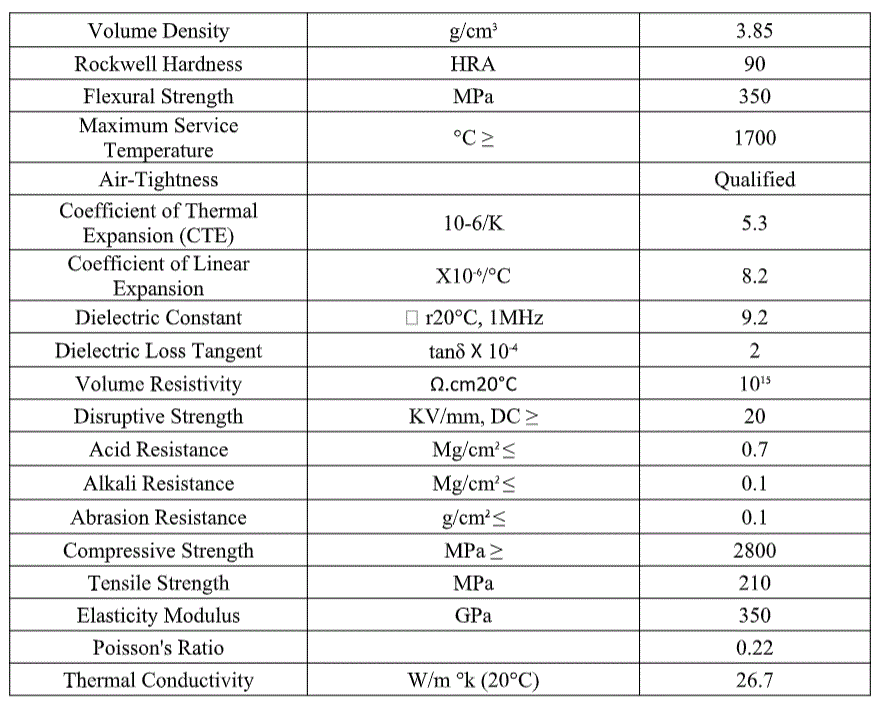
What are the engineering properties of your alumina products?
What should I pay attention to when I use alumina products?
- Alumina products are fragile. Please handle them carefully and avoid collision during unpacking, transportation, handling and cleaning.
- Check whether any micro-cracks exist before using alumina products. Products with micro-cracks should not be used.
- Alumina products should be completely dry before usage. If they get wet, let the crucible or tube dry naturally before using them. If dry crucibles by placing in a dryer or oven, make sure that the dry process goes slowly.
- Do not load too many materials in alumina crucibles, which can increase the possibility of uneven heating.
- Alumina crucibles are sensitive to thermal shock. Try to warm up the furnace chamber slowly. A heating rate of 150°C/hour is recommended for the first 1-1.5 hours so that the crucibles can be evenly heated to reduce the impact of thermal shock. It usually takes about 3 hours to increase to high temperature.
- Lower the temperature as gradually as possible. The cooling down rate is often half of the heating rate. If possible, arrange for consecutive heating of furnace to maintain a hot crucible. If taking the crucibles out of furnace into room temperature to pour the melted material, try to control the process as short as possible.
- Avoid contact of heated alumina products with a cold surface. Use insulation materials as support of alumina crucibles.
- Alumina crucibles should not be heated by torch or furnaces that cannot control temperature change rate. The uneven heating can cause crack.